Park a boat on an open-water mooring in Newport Harbor, with no dock, no land connection, nothing but a can and a chain, and you will pay more in monthly rent than the owner of a multimillion-dollar bayfront home pays for the private dock bolted to the back of their property. That is not a typo and it is not a temporary quirk. It is the current, official finding of the agency that oversees California's public waterways, and it is the reason every Newport Harbor dock permit in circulation right now is being repriced.
If you are buying or selling waterfront property in Newport Beach this year, this is the fact that changes how you read a listing. The dock is not an amenity that conveys with the house the way a built-in wine fridge does. It is a permit, on public land, priced by a system the state has just told the city to fix.
What You're Actually Buying When You Buy the Dock
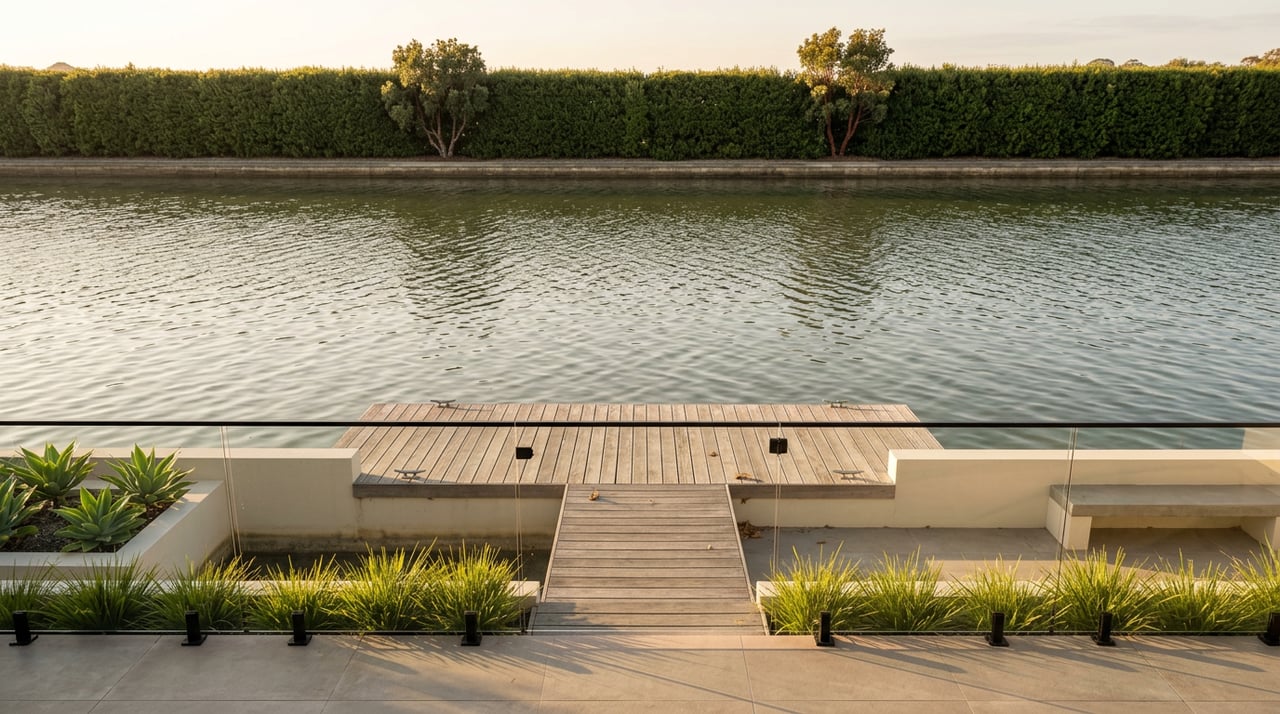
Newport Harbor holds more than 9,000 recreational vessels along roughly three miles of waterfront, and the City of Newport Beach administers more than 850 permitted residential piers behind bayfront homes. Nearly all of that water is tideland, held in trust for the State of California and managed by the city under an arrangement that dates to the Beacon Bay Bill of 1978. When a bayfront home sells, the buyer does not acquire the water, the submerged land, or even the dock as a standalone piece of property. What transfers is a permit that allows a private dock to sit on public trust land.
That distinction sounds academic until you are the one signing closing documents. It means the value sitting behind a bayfront house, the part that lets a family keep a boat steps from their back door instead of driving to a marina, is really a lease relationship with the city. And leases can be repriced.
The Escrow Moment Most Buyers Miss
The city's own process for transferring a pier permit is specific and worth understanding before you are inside a thirty-day escrow. Both buyer and seller submit an application with a transfer fee, and both sets of signatures are due at close of escrow. The city then inspects the dock. Turnaround runs five to fifteen working days, and if the pier does not meet safety requirements, you get a letter listing what needs to be corrected before the permit will move into the new owner's name.
That inspection is a real point of friction, not a formality. A dock that has quietly needed pile, decking, or electrical work for years can surface exactly when a deal is closing, and who pays for the fix becomes a negotiation. Ordering an independent dock inspection during your own contingency period, rather than waiting for the city's inspection late in escrow, gives a buyer room to negotiate repairs while there is still leverage to walk away.
The city's rules also cap how far a dock can extend. Municipal Code Section 17.35 governs pier and float extensions beyond the pierhead line in Newport Harbor, and those harbor lines are essentially fixed. A property with a wide gap between its bulkhead and the pierhead line can hold a larger boat than a neighbor with a narrower one, and no amount of renovation changes that. On Balboa Island specifically, new noncommercial piers are not approved unless the Harbor Commission finds the pier to be in the public interest, which in practice means an existing permitted dock is worth more than the prospect of building a new one.
The Number That Doesn't Add Up
Here is the discrepancy that triggered the state's involvement. According to the staff report reviewed by the California State Lands Commission, a 40-foot mooring permit, essentially a parking spot for a boat in open water with no land access, typically resells on the private market for $40,000 to $60,000. Meanwhile, the commission found that residential dock rents, for docks physically attached to bayfront homes, have not kept pace with anything resembling fair market value.
| Offshore Mooring | Residential Dock Permit | |
|---|---|---|
| Connected to land | No | Yes |
| Access | Requires dinghy or kayak | Walk out your back door |
| Typical private resale value (40 ft) | $40,000–$60,000 | Not sold separately from the home |
| Appraisal practice | Regular, market-based | Under review after years without fresh appraisal |
| Regulatory status in 2026 | Rate increase found reasonable by state | Rents found too low; new appraisal ordered |
The state's language on this was blunt. At the December 16, 2025 meeting where the California State Lands Commission approved its report, commission chair and Lieutenant Governor Eleni Kounalaki put it this way:
"We now can see clearly that the rates being charged for the piers are too low."
The commission directed the city to commission a new independent appraisal of residential pier leases, reconsider how it calculates the rentable area of a dock, and investigate whether piers that are quietly subleased are being billed at the commercial rate they should be. Separately, the commission also raised concerns that the long-standing practice of privately selling mooring permits, the same $40,000 to $60,000 transactions, may not comply with the city's obligations as a public trustee, and recommended the city move away from allowing those private transfers altogether.
What the Timeline Actually Looks Like From Here
None of this happens overnight, and the city has been explicit that no rate increase or transfer restriction takes effect without City Council approval and public notice. The published sequence runs through new independent appraisals across residential piers, moorings, and yacht clubs in 2026, a series of public community meetings that began on May 27, 2026, continued engagement through the rest of the year, and a comprehensive policy package brought to the City Council in 2027.
That means a buyer closing on a bayfront home today is not stepping into a settled system. They are stepping into the early middle of a multi-year repricing that the city itself initiated in response to a legal finding, not a budget shortfall.
What This Means If You're Buying or Selling This Year
For sellers, this is a moment to be precise rather than vague about the pier permit attached to the property. Buyers are going to ask, and having your current annual pier rent, your most recent inspection status, and any sublease history documented in writing shortens the path to closing.
For buyers, the practical move is simple: ask for the seller's current annual pier rent in writing, and treat that number as a floor rather than a fixed cost. Given the direction of the State Lands Commission's findings, underwriting the possibility of a higher rent in the next lease cycle is more realistic than assuming today's number holds. If you plan to sublease a dock rather than use it yourself, pay close attention to how this process unfolds, since subleased piers are one of the specific practices under review.
And if you are comparing two bayfront homes with similar square footage, look past the house entirely and ask what the water behind it can actually hold. Two identical structures on the same street can carry very different values once you account for the distance between the bulkhead and the pierhead line, and for the current status of the pier permit itself.
A Few Questions Worth Asking Before You Write an Offer
Does the pier permit transfer automatically when I buy the house? No. It requires a formal application to the City of Newport Beach Public Works Department, signed by both buyer and seller at close of escrow, along with a transfer fee and a city inspection of the dock.
Can I make an existing dock bigger? Only up to the pierhead line, and extending beyond it requires Harbor Commission approval, which is the exception rather than the rule. On Balboa Island, new piers are approved only when the Harbor Commission finds them to be in the public interest.
Is my pier rent about to go up? Possibly, and the city has said as much. Following the State Lands Commission's December 2025 report, new appraisals are underway in 2026, with a full policy package expected to reach the City Council in 2027. No changes take effect without council approval and public notice, but the direction of the finding points toward higher rates rather than lower ones.
Waterfront property in Newport Harbor has always come with more moving parts than the price per square foot suggests. Right now, one of those parts, the permit governing what sits in the water behind the house, is being rewritten in real time. Buyers and sellers who understand that going into escrow are the ones who negotiate from a position of knowledge rather than surprise.
If you are evaluating a specific bayfront listing, or thinking about what your own dock permit is really worth in this environment, Adam Loucks can walk through what the current harbor review means for your property specifically.